
Prep for your quant interviews, every day.
One real question a day in probability, market making, financial maths or stats, with a worked solution. Your mistakes come back until you get them right. And once the interview is behind you, a way to keep your edge.
 Start for free.
On iPhone, iOS 17 or later.
- 351questions, each with a hint and a worked solution
- 44skills, from level I to level V
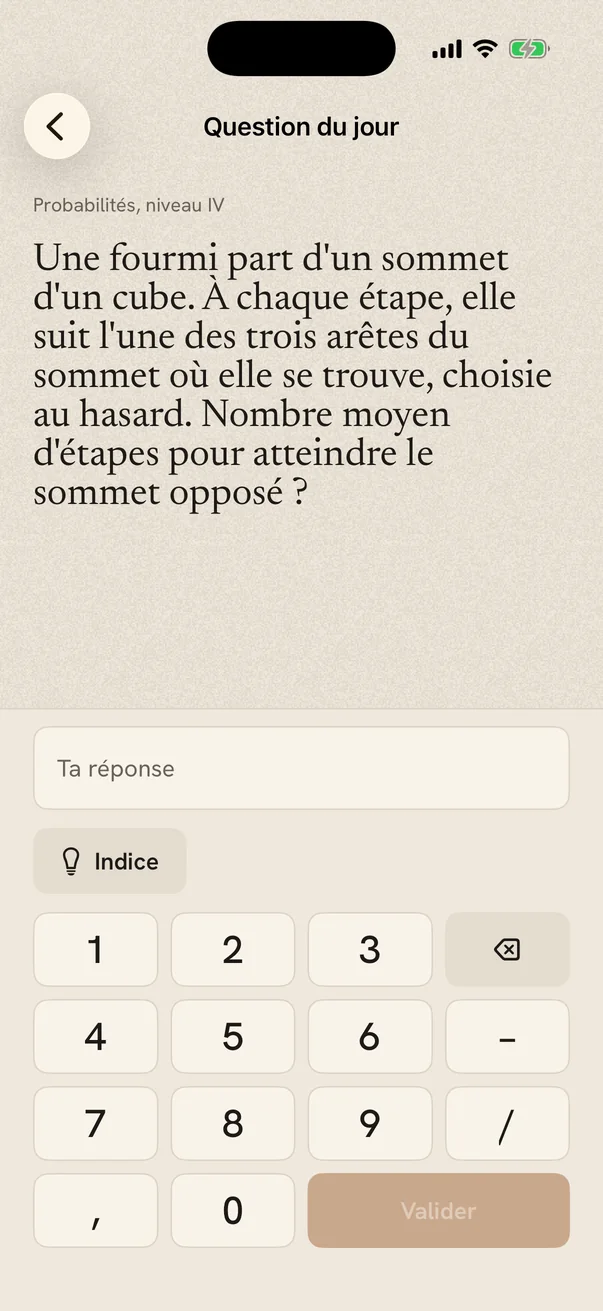
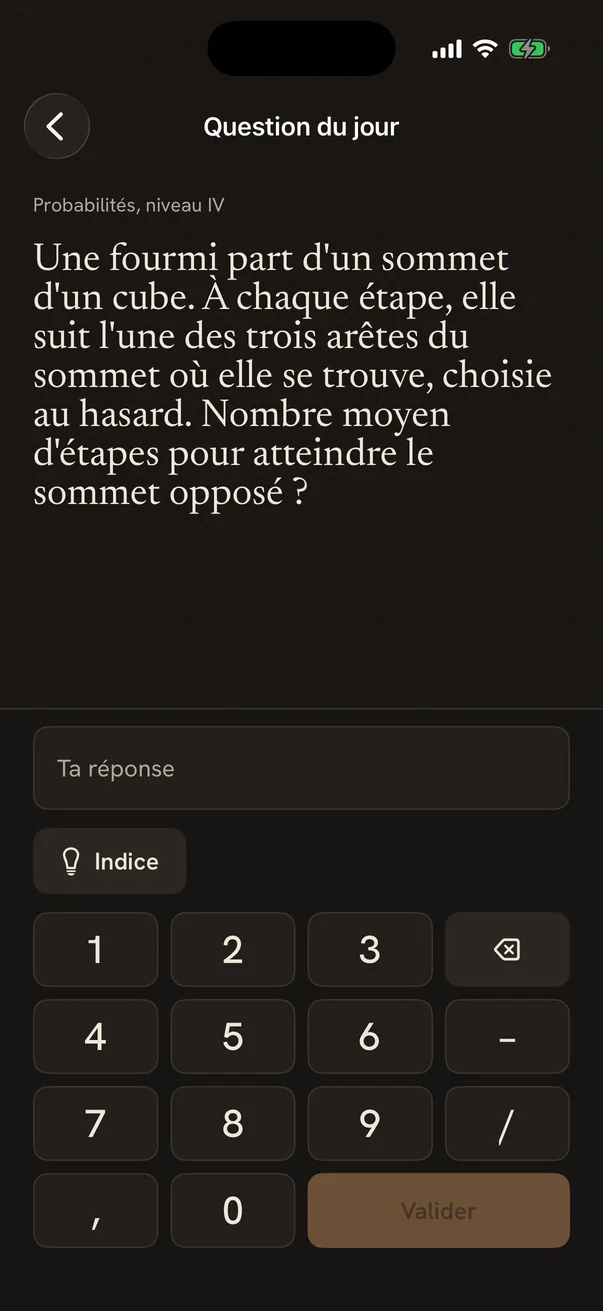
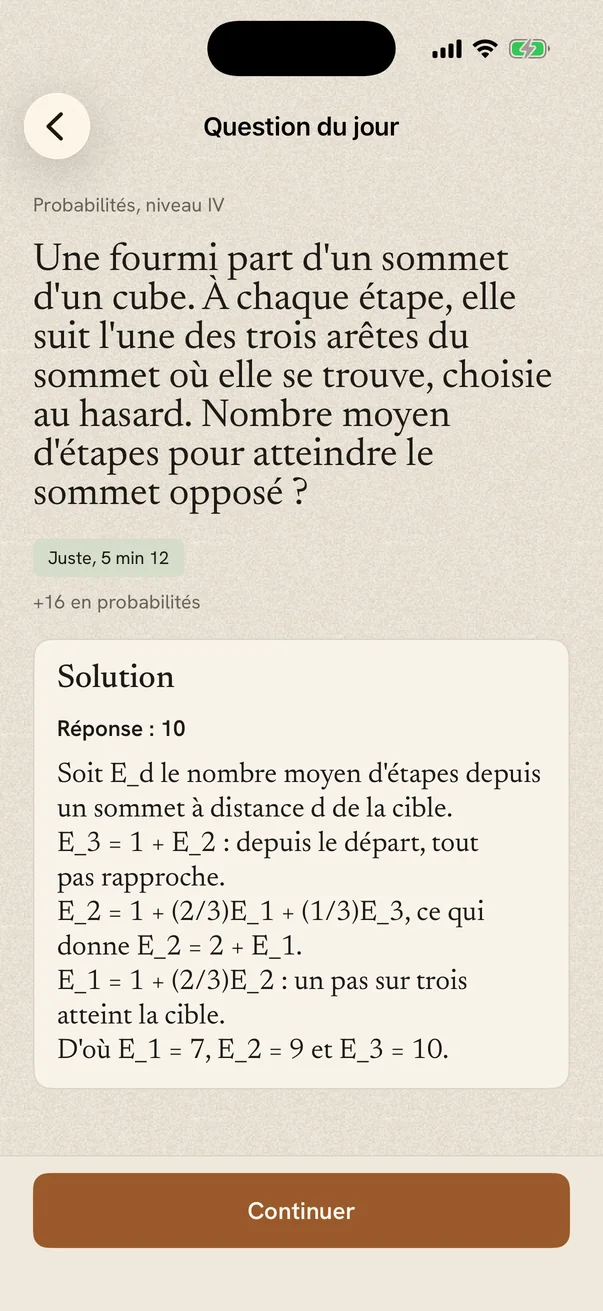
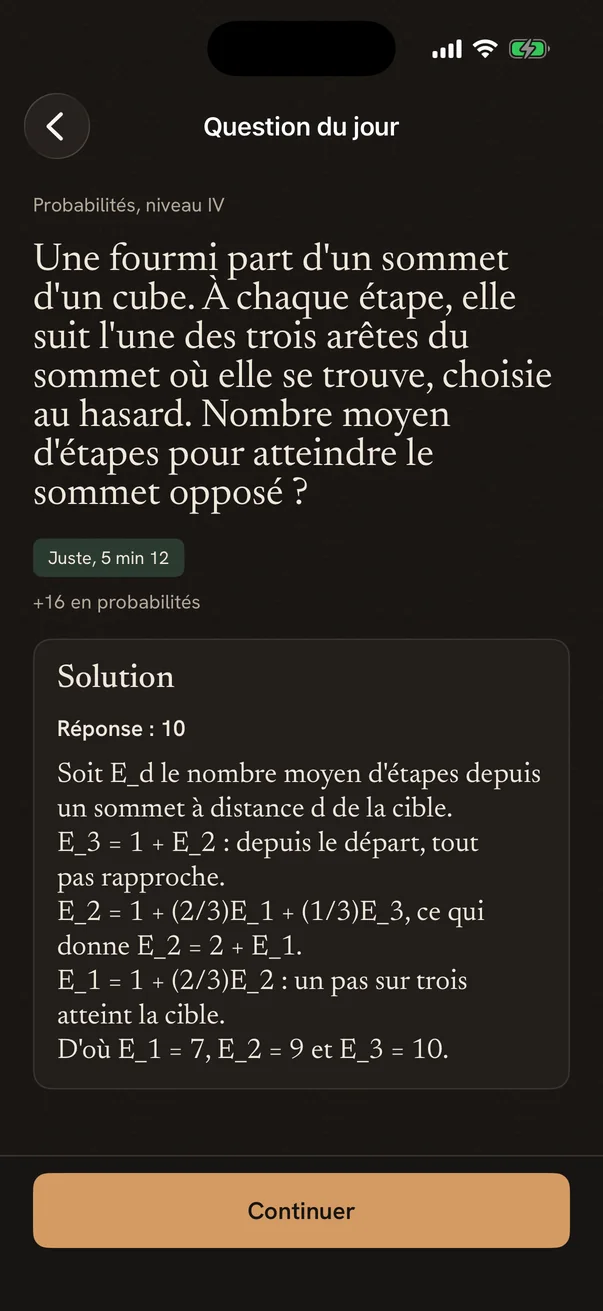
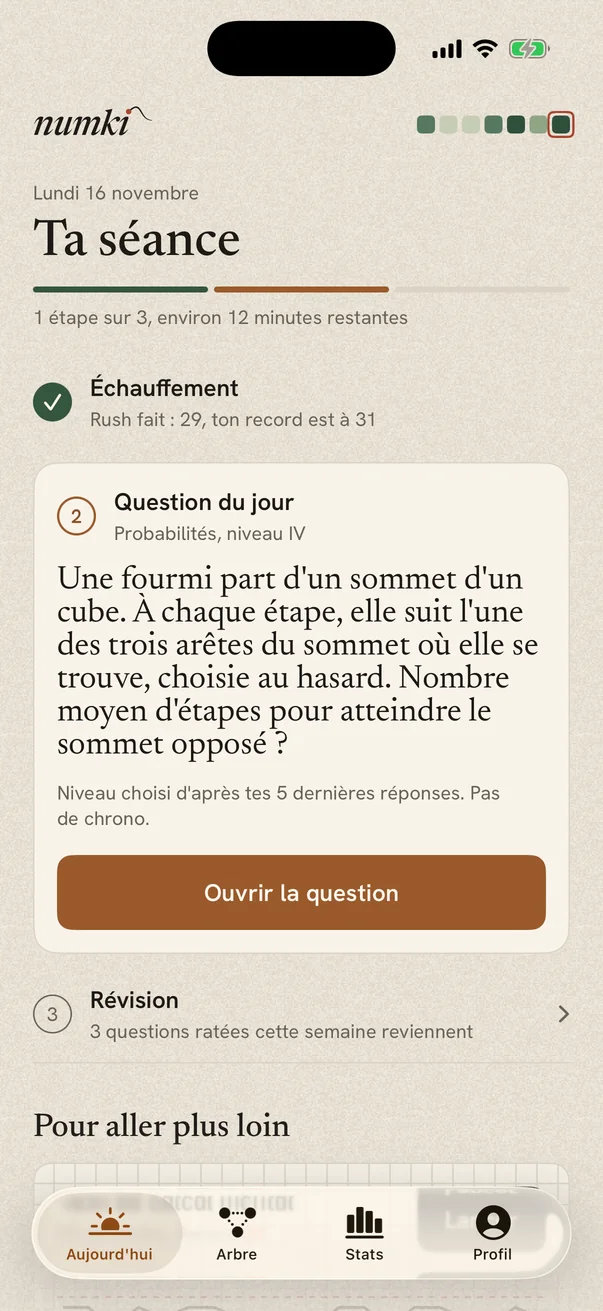
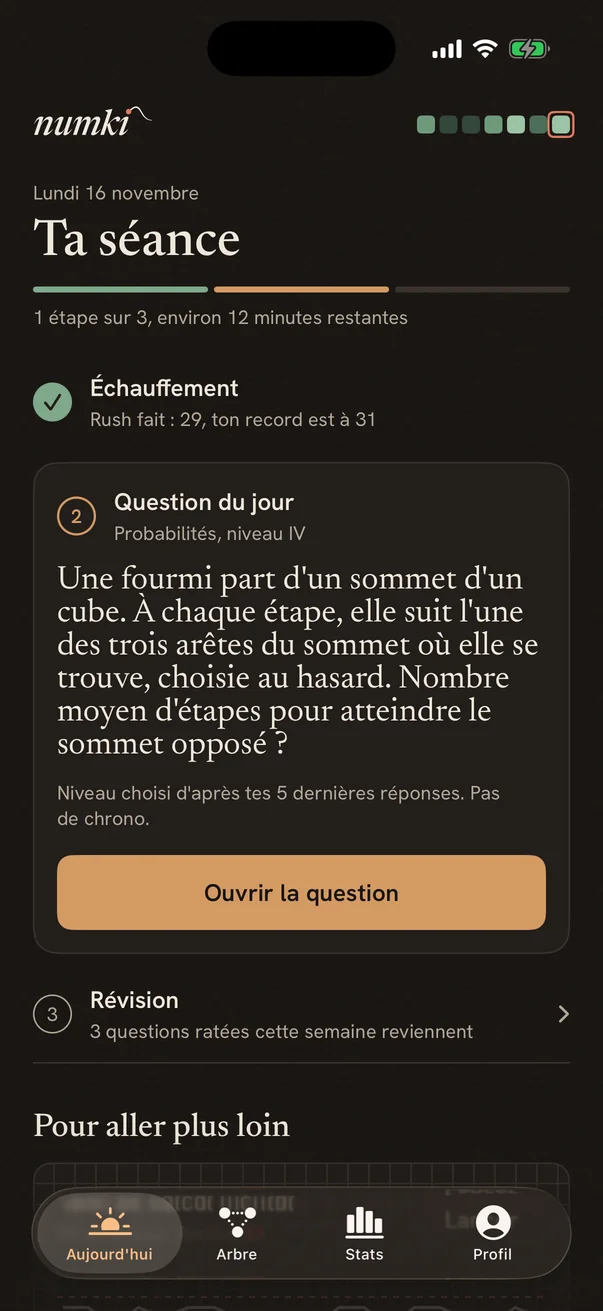
The question of the day: take the time you need.
Every day, a question at your level, picked from your latest answers.
Question of the dayProbabilityLevel IVNo timer
You roll a fair die until you get two sixes in a row. How many rolls does it take on average?
Worked solution. Two states: E from the start, F just after a six. E = 1 + one sixth of F + five sixths of E. F = 1 + five sixths of E, because a six ends it, otherwise you start over. Substituting F: E = 7/6 + 35/36 E, so E/36 = 7/6, and E = 42.
Check it by experiment. Roll the dice, or simulate a thousand games at once.
Roll until you get two sixes in a row.
The average takes shape, game after game.
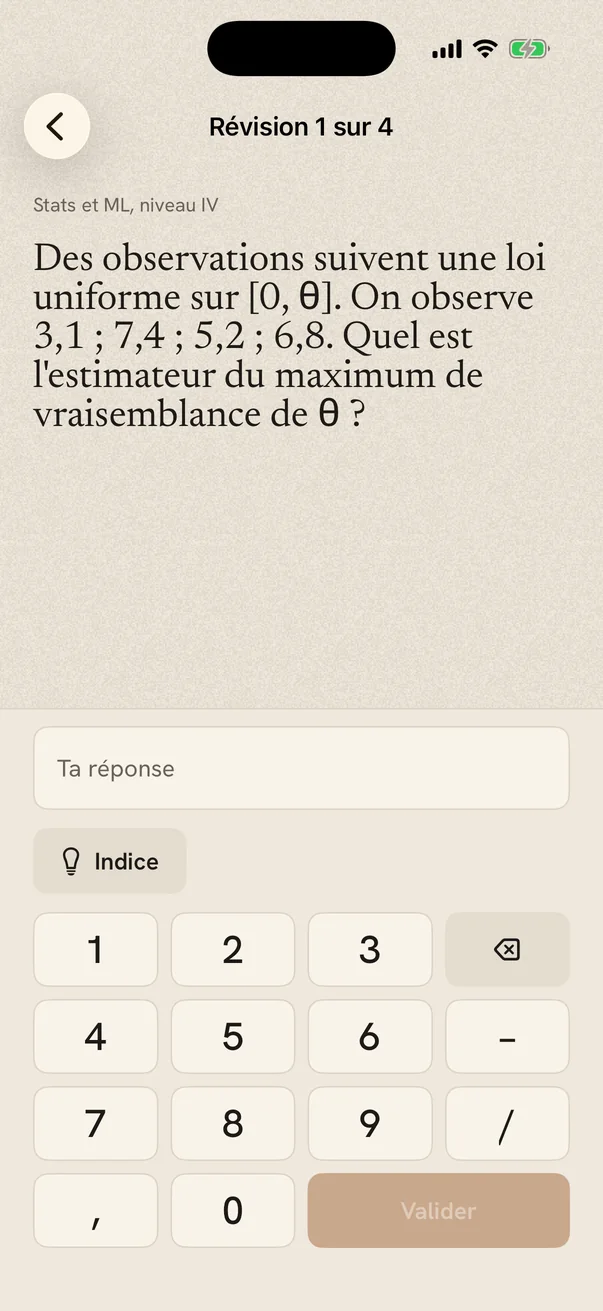
Your mistakes come back until you get them right.
A question you miss comes back in your next sessions. You redo it cold, with the method in mind, and it only leaves your list the day you get it right. That is where real progress happens.
- You place 4 random points on a circle. What is the probability they all lie in the same semicircle?
- Monday1/4missed, it goes into your review
- Tuesday3/8it comes back, missed again
- Thursday1/2right, it leaves your list
Every session opens with 90 seconds of mental maths, against your own best.
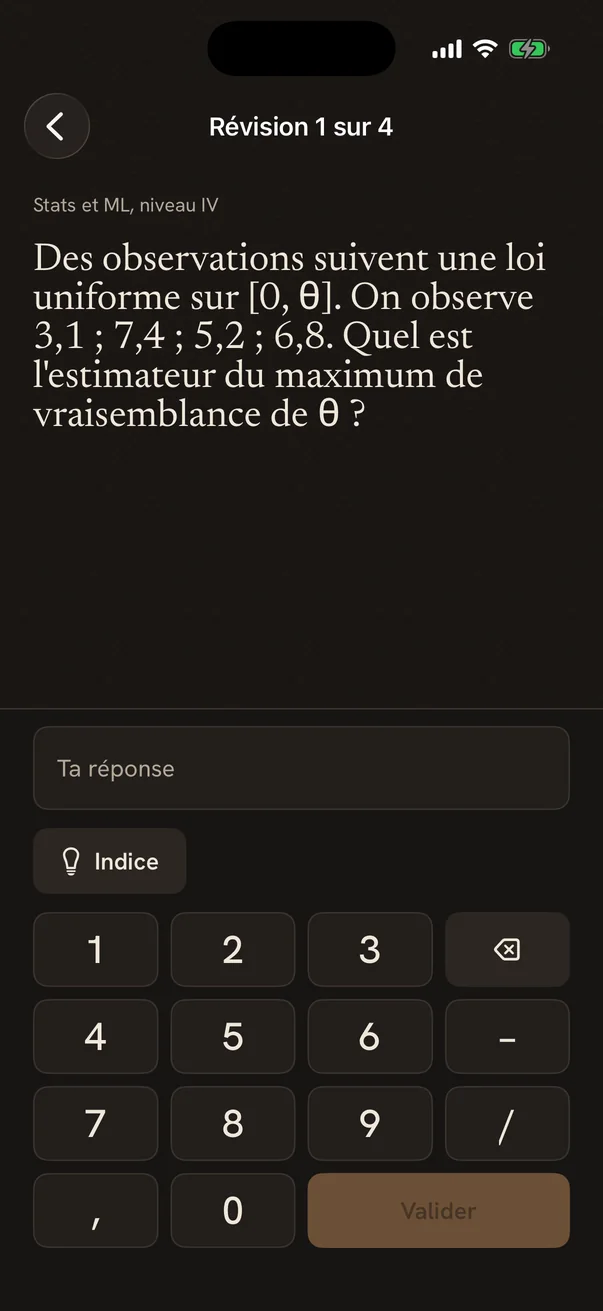
The reasoning counts as much as the answer.
In an interview, they listen to how you reason as much as they wait for your answer. Every Numki question has a worked solution, step by step. Here are four questions from levels IV and V, exactly as they appear in the app.
You draw independent uniform numbers on [0, 1] until their sum exceeds 1. How many draws on average?
Hint. What is the probability that the sum of the first n draws is still below 1?
Worked solution. Let N be the number of draws. N is greater than n if and only if the sum of the first n draws is at most 1. That probability is the volume of a simplex: 1 over n factorial. The expectation of N is the sum of P(N > n), so the sum of 1/n!, which is e, about 2.718.
A security will be worth 90 or 110, with equal odds. 25% of clients know the value and buy if it is 110, sell if it is 90; the others buy or sell at random. Where do you set your ask so that a buy has zero expected profit?
Hint. Work out P(buy | 110) and P(buy | 90), then apply Bayes.
Worked solution. P(buy | 110) = 0.25 + 0.75 × 1/2 = 0.625. P(buy | 90) = 0.75 × 1/2 = 0.375. By Bayes, P(110 | buy) = 0.625. The ask is the expected value given a buy: 0.625 × 110 + 0.375 × 90 = 102.5. The half-spread of 2.5 exactly offsets the losses to informed clients.
A stock is at 100 and, in each of two periods, is multiplied by 1.2 or by 0.8. Risk-free rate: 5% per period. What is the American put with strike 100 worth?
Hint. At each node, compare the discounted continuation value with immediate exercise.
Worked solution. Risk-neutral probability q = (1.05 − 0.8) / (1.2 − 0.8) = 0.625. At expiry, the put pays 0 if the stock is at 144, 4 if it is at 96, 36 if it is at 64. At node 120, continuation is worth about 1.43: wait. At node 80, continuation is worth about 15.24, less than immediate exercise at 20: exercise. At the root, the put is worth about 7.99.
You average the predictions of 5 models. Each model's error has variance 4, and the errors of any two models have correlation 0.25. What is the variance of the error of the average?
Hint. Count the n variances and the n(n − 1) covariances.
Worked solution. The variance of the average is 1/n² times (n σ² + n(n − 1) ρ σ²) = 1/25 × (5 × 4 + 20 × 0.25 × 4) = 40/25 = 1.6. Another form: ρσ² + (1 − ρ)σ²/n = 1 + 0.6. The correlated part never goes away, even with many models.
Go as far as you like.
Today's session is only the start. Practise freely across all 351 questions, target your weak spots, steer your sessions towards your interviews.
-
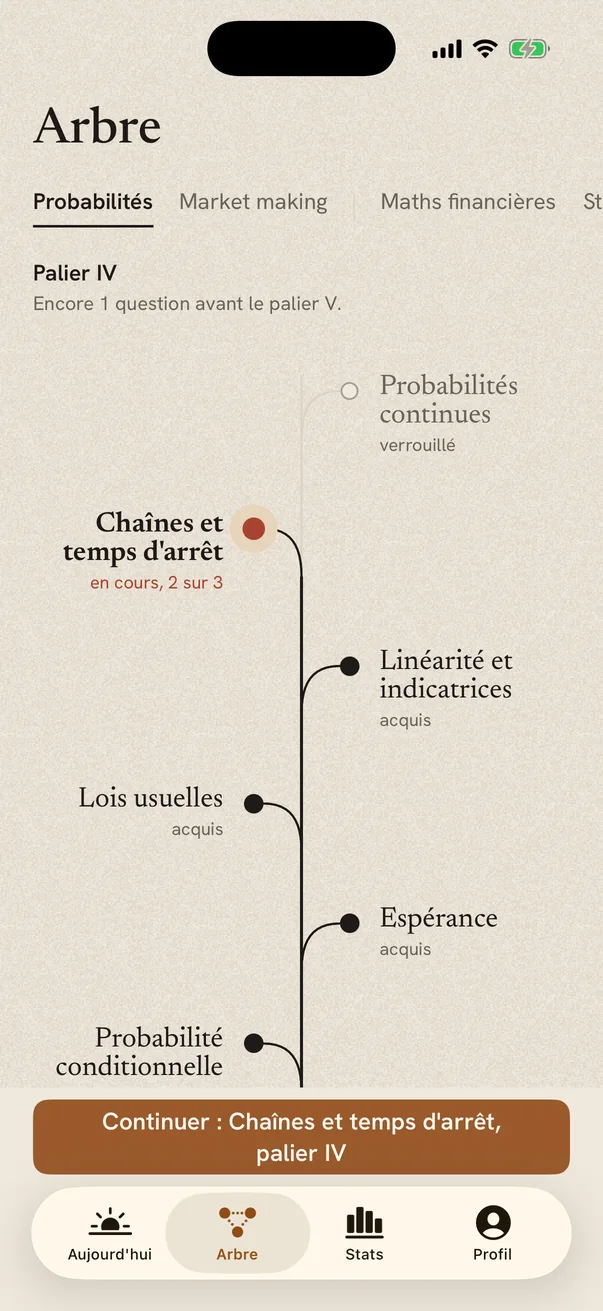
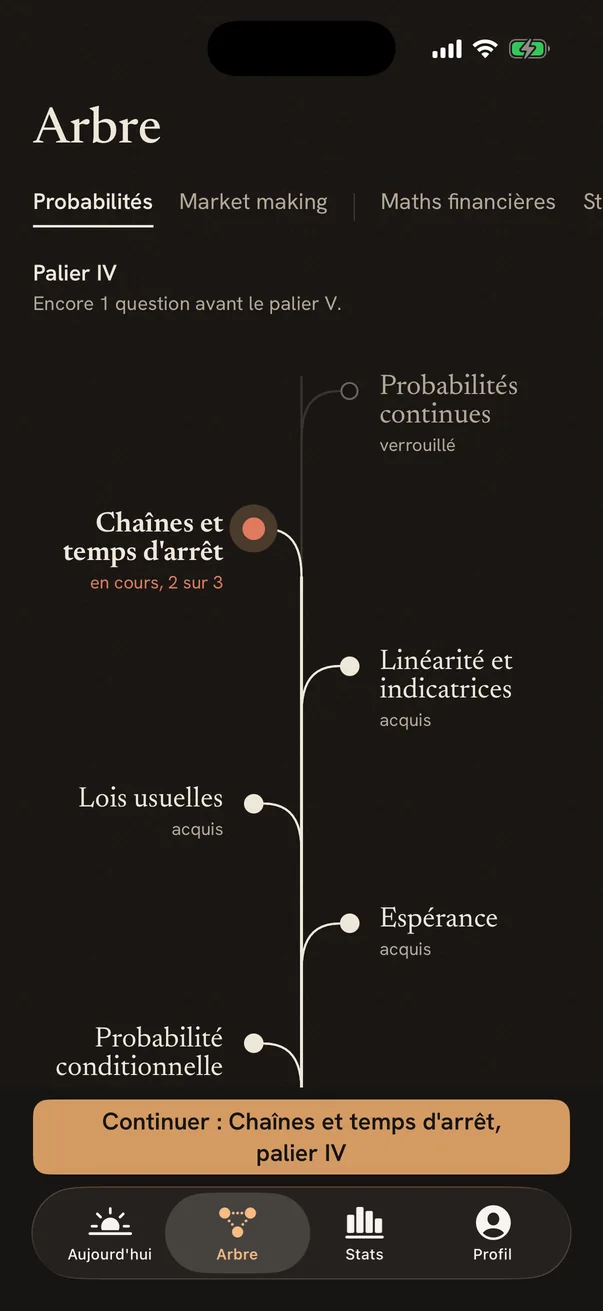
The Tree
All 351 questions sorted into 44 skills across five levels. You move at your own pace, level after level.
-
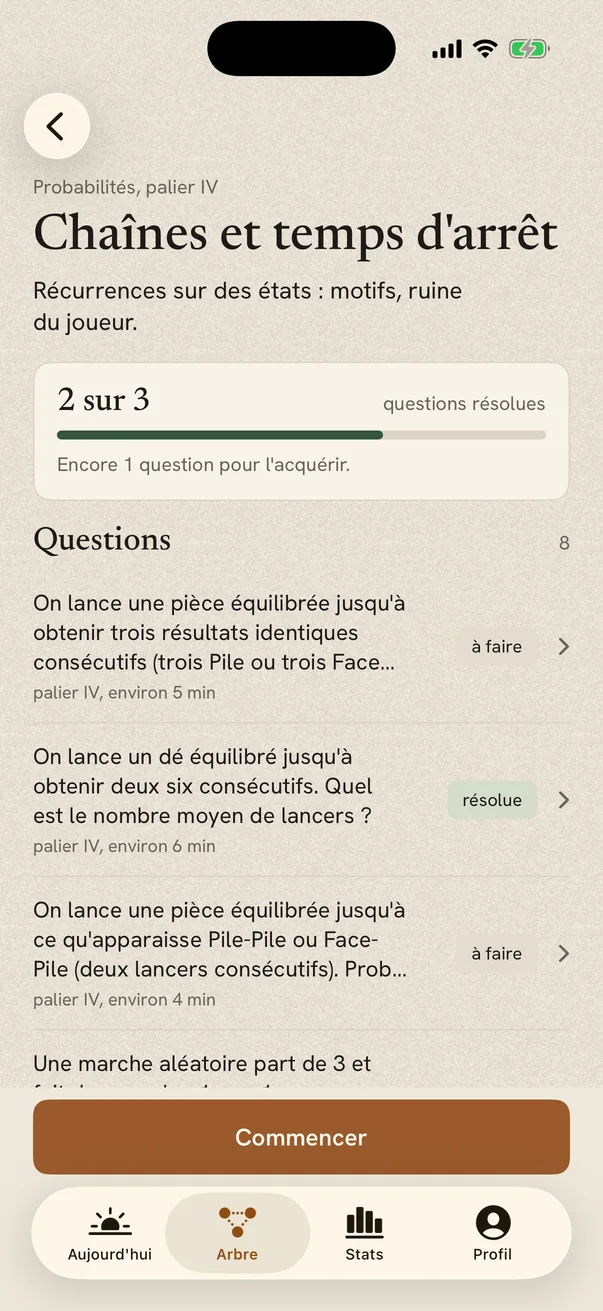
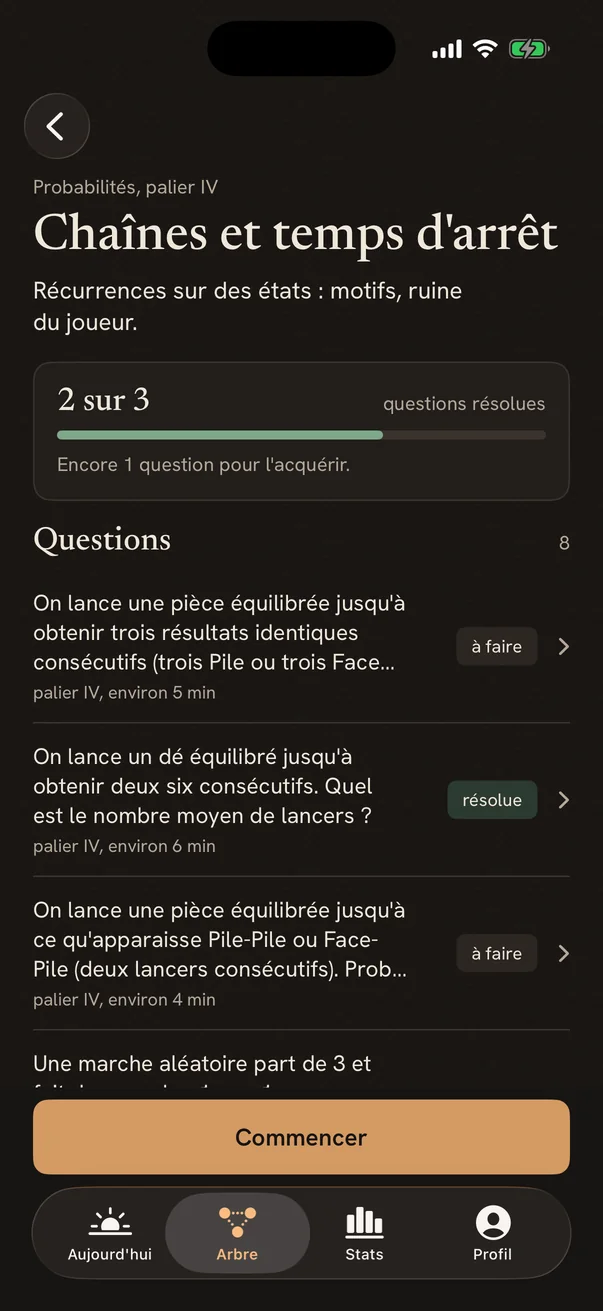
One skill at a time
Its questions, what you have left to master it, the next level in sight.
-
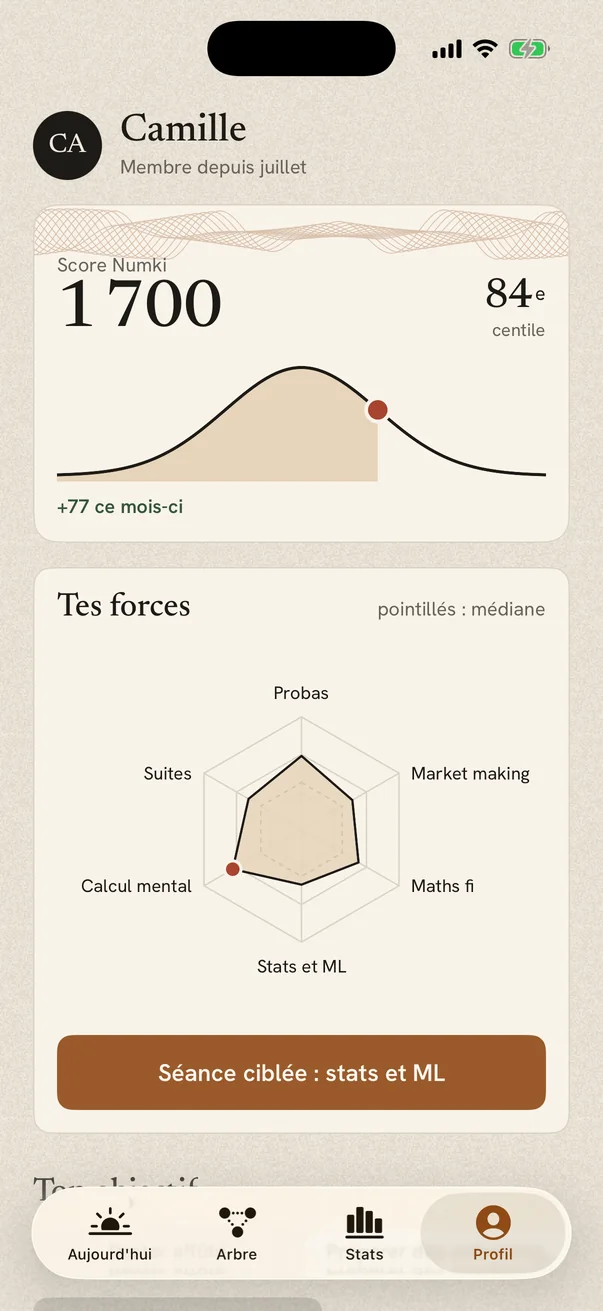
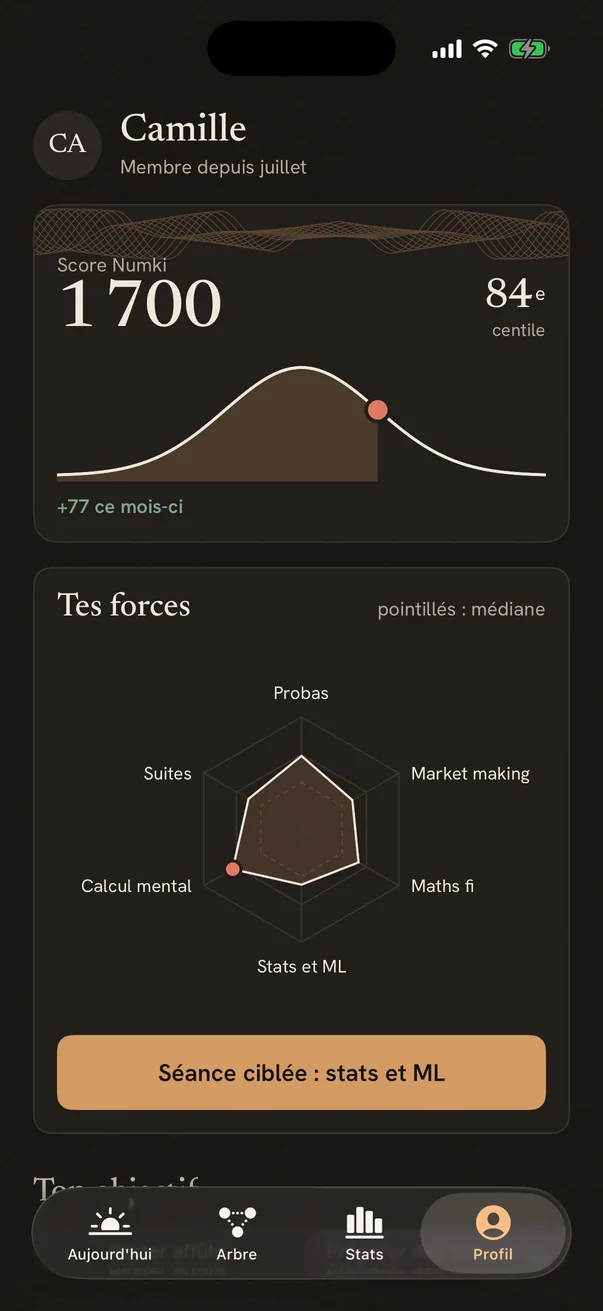
Targeted sessions
Your radar spots your weakest category. A whole session to bring it back up.
-
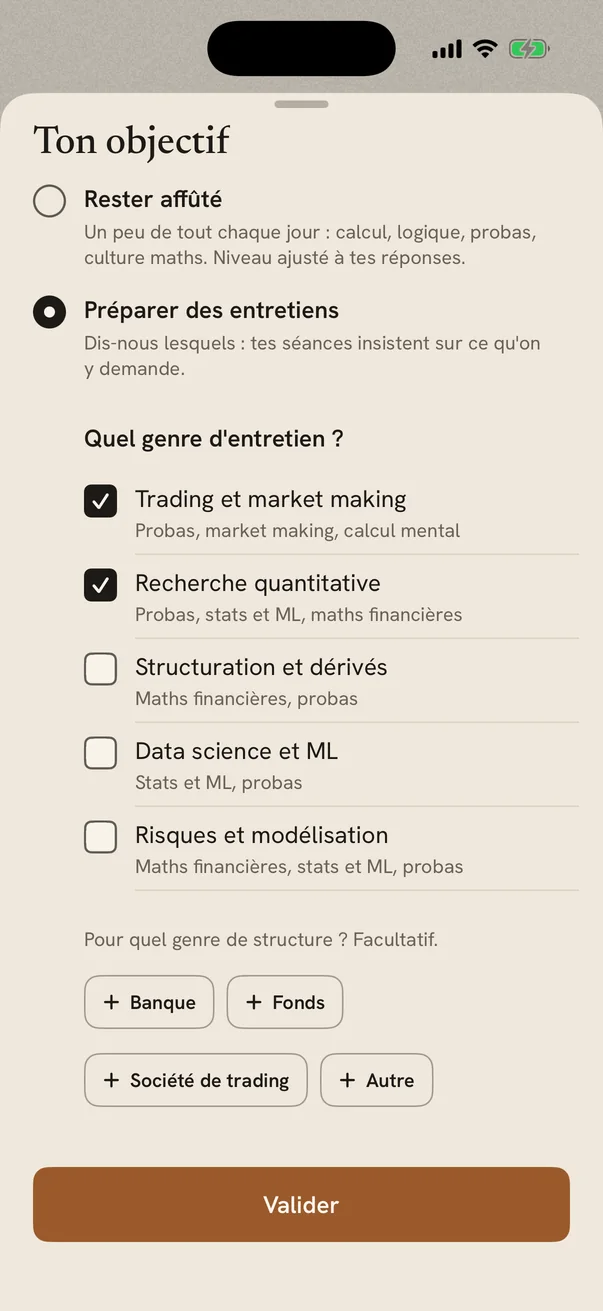
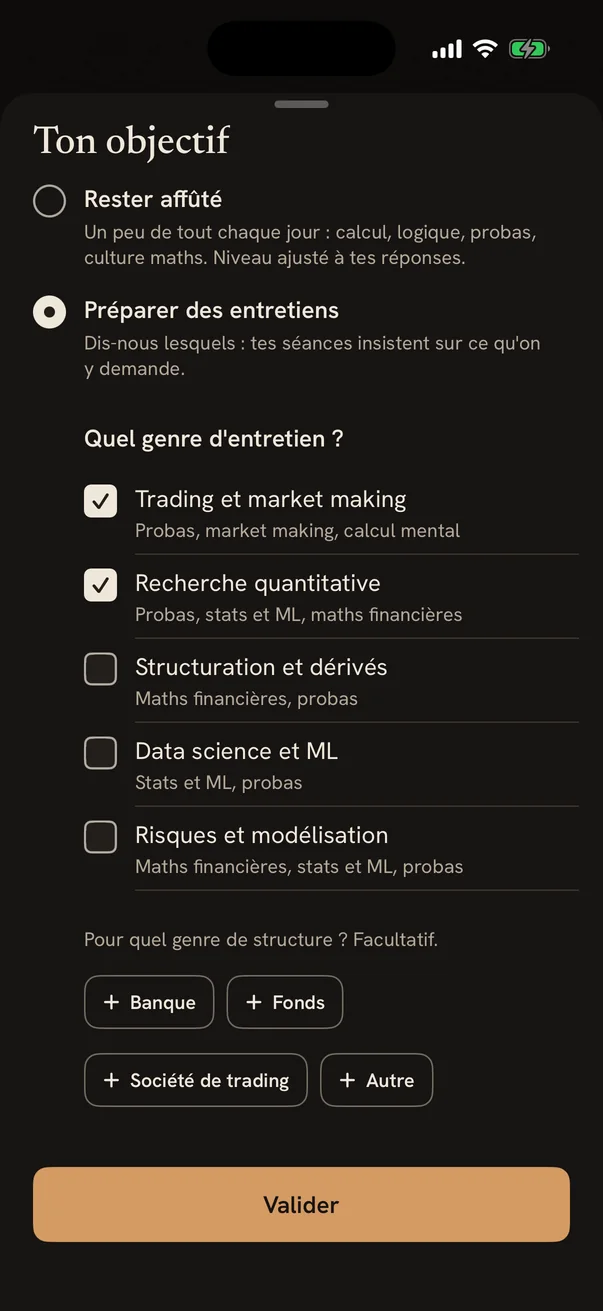
Interview mode
Tick what you are preparing for: trading, quant research, structuring… Your sessions focus on what those interviews ask.
-
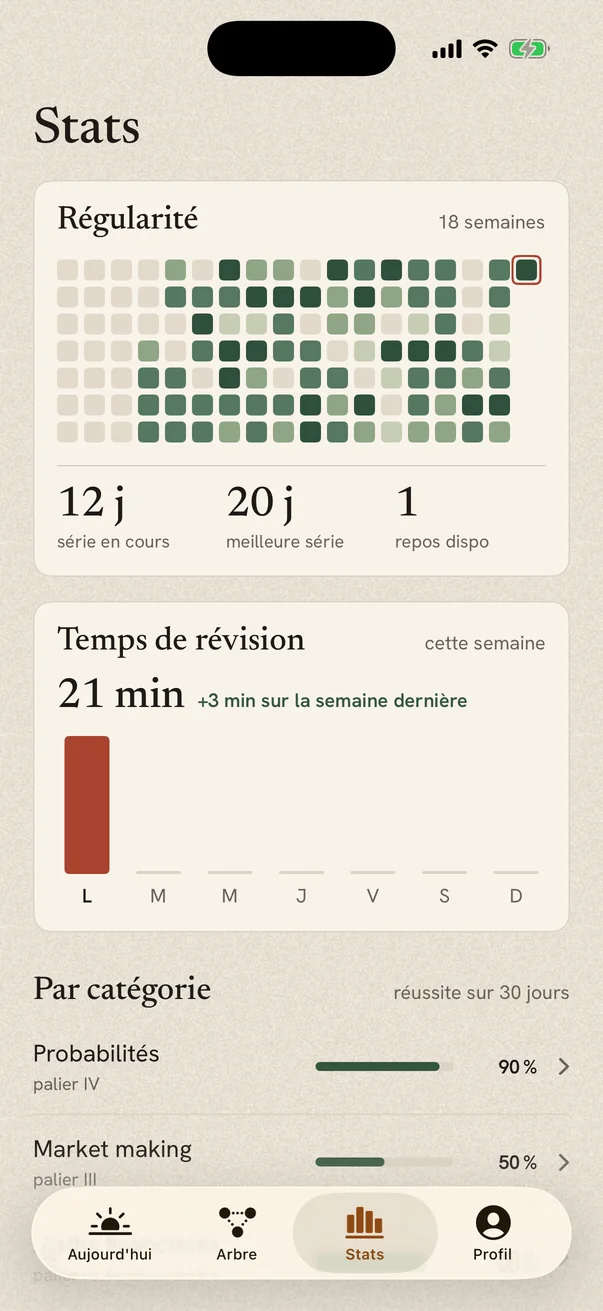
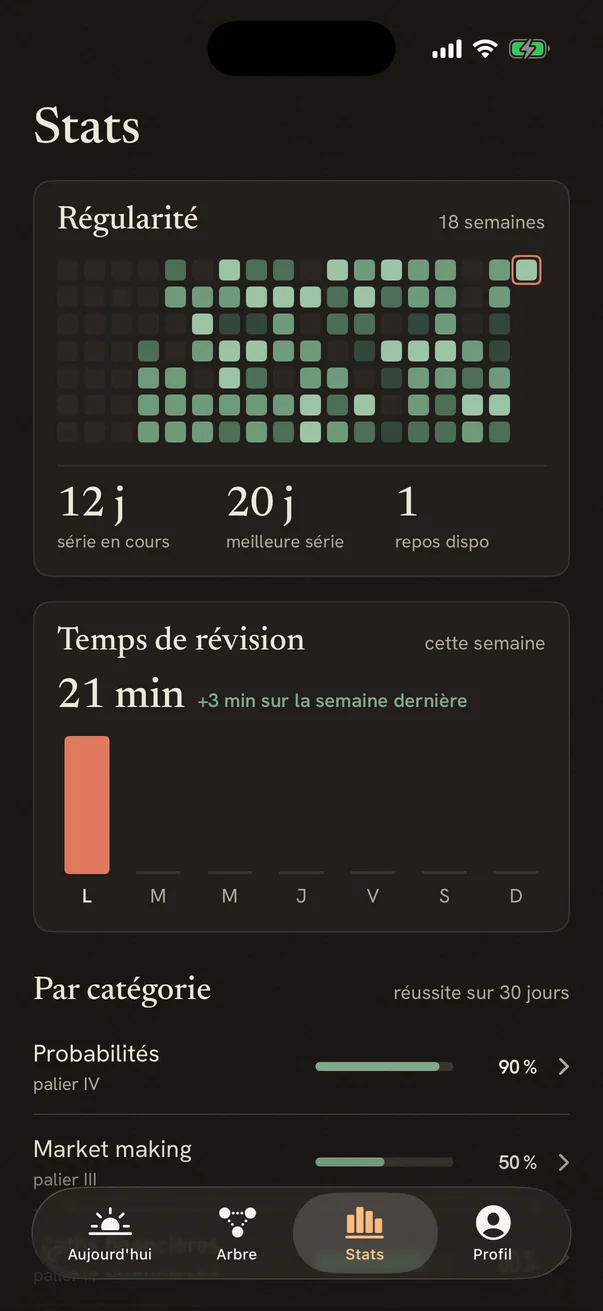
Your stats
Your consistency, your success by category, your best score: proof that you are moving forward.
-
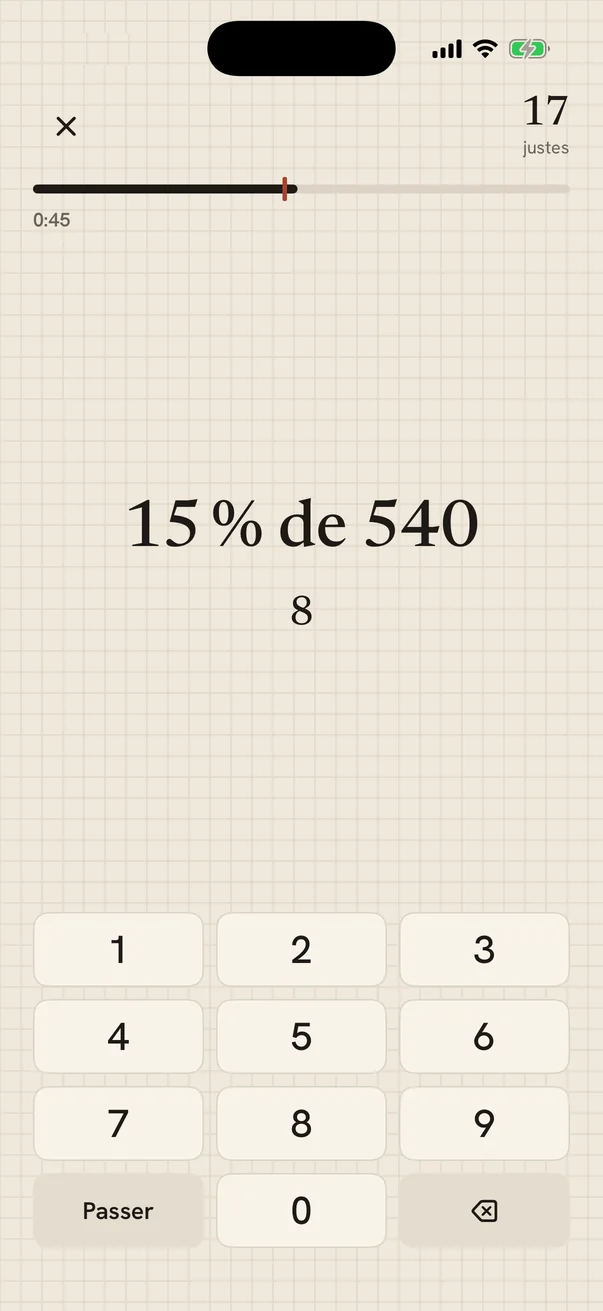
The Rush
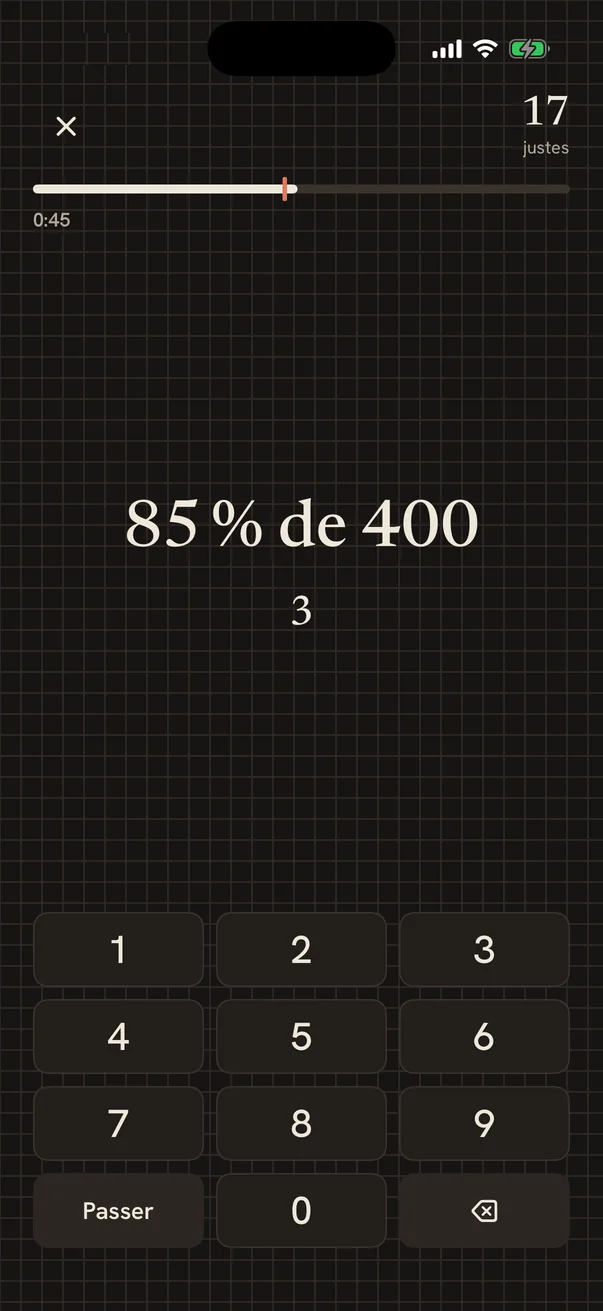
90 seconds of mental maths, on squared paper. Your best waits for you as a dotted line.
351 questions that climb all the way to level V.
Six categories, 44 skills, five levels. Questions in the spirit of trading and quant research interviews, and classics worth solving again. Each with a hint and a worked solution.
- 69Probability
- 57Market making
- 61Financial maths
- 62Stats and ML
- 42Mental maths
- 60Sequences
Puzzles
Think before you calculate.
You draw two cards from a 52-card deck, without replacement. What is the probability they are the same suit?
See the answer
4/17, about 23.5%. Whatever the first card, 12 cards of its suit remain among the other 51.
Make me a market on the product of two fair dice. Where do you centre your spread?
See the answer
12.25. The dice are independent, so E[XY] = E[X] × E[Y] = 3.5 × 3.5. All that is left is choosing how wide to quote.
Theory
The tools of the trade, one question at a time.
A European call with strike 100 is worth 7, the underlying trades at 102, zero rates, no dividend. What is the put with the same strike and expiry worth?
See the answer
5. Put-call parity with zero rates: C − P = S − K, so P = 7 − 102 + 100.
1% of transactions are fraudulent. A model flags 99% of frauds, but also 1% of honest transactions. A transaction is flagged: what is the probability it is fraud?
See the answer
50%. Out of 10,000 transactions, 99 frauds are flagged, and so are 99 honest ones.
Drill
Timed, on squared paper. Reflexes more than ideas.
17 × 23
See the answer
391. (20 − 3)(20 + 3) = 400 − 9.
2, 6, 12, 20, 30, ?
See the answer
42. The n-th term is n(n + 1): the gaps grow by 2 each time.
Mental maths is trained against the clock.
The Rush opens every session: 90 seconds, no Submit button, a correct answer moves on by itself. Your only opponent is your own best. Watch a game, then take over (30 seconds here).
Addition, times tables, exact division, percentages, squares. And 60 sequence questions alongside.
The Rush, 30 seconds of mental maths
Make me a market
Roll two fair dice and multiply the faces. Where do you centre your spread?
A trading interview classic: quote a bid and an ask, then stand by your price. Here, a spread from 11 to 13.50: watch where twenty games land.
In the app, 57 market making questions: expectations, spreads, adverse selection, the Kelly criterion.
Twenty games, two dice each time.
Your goal shapes your sessions.
You pick it in your profile, and change it whenever you like.
You are preparing for interviews
Trading, quant research, structuring, data science, risk: tick what you are preparing for. Your sessions focus on what those interviews ask.
What kind of firm? Optional.
Your sessions focus on
- One or more kinds of interview, and the kind of firm if you like: bank, fund, trading firm.
- Sessions targeted at your weakest category.
- Worked solutions, to practise explaining your reasoning out loud.
- Once your interviews are done, switch back to "Stay sharp" in one tap.
You want to stay sharp
You miss the maths from your studies a little. A short session every day, for the pleasure of solving and the habit of coming back to it.
- A forgiving streak: one rest day a week, without losing it.
- Your consistency at a glance, week after week.
- No public leaderboard: you compete with your own best.
- Your progress in concrete steps, "2 more questions to level IV".
Why Numki?
To prepare for an interview, people often juggle a book, flashcards and a mental maths website. Here is what each one does.
| NumkiiPhone app | Green Bookinterview book | Ankiflashcards | Zetamacmental maths | |
|---|---|---|---|---|
| An iPhone app | Yes | A book | Yespaid on iPhone | A website |
| Built for quant interviews | Yes | Yes | General purpose | Arithmetic only |
| Timed mental maths | Yes90 s Rush | No | No | Yes30 s to 10 min |
| Your mistakes come back until you get them right | Yes | No | Yesspaced repetition | No |
| A worked solution for every question | Yes | Yesover 200 problems | Depends on your cards | No |
Based on each tool's official pages, November 2026. They complement each other: nothing stops you using them together.
Frequently asked questions
Another question? Write to contact@numki.app.
What is Numki?
An iPhone app for daily quantitative maths practice: mental maths, probability, market making, financial maths, stats and ML, sequences. Every day, a short session: the question of the day, a review of your mistakes, and a mental maths warm-up to start.
Who is it for?
For students preparing for trading, quant research or structuring interviews, and for anyone who enjoyed maths and wants to keep doing a little every day. The level adjusts to your answers: the first questions are approachable, the next ones more demanding.
Is it iPhone only?
Yes, iOS 17 or later. There is no Android or web version for now.
Do I need an internet connection?
No. The questions live in the app: your session works on the underground or on a plane too.
Which languages?
French and English. The questions, hints and solutions are written in both languages.
How much does it cost?
Nothing to start: today's session is free, and will stay free. To go further (free practice, targeted sessions, interview mode), Numki Club is available in the app; its price is shown before you confirm anything.
Can I try before I pay?
Yes. Today's session is free forever, and the annual Numki Club subscription starts with a 7-day trial: cancel before it ends and you pay nothing.
Can I cancel at any time?
Yes. If you subscribe to Numki Club: in Settings, tap your name, then Subscriptions. The subscription stays active until the end of the period already paid.
What do you do with my data?
This site sets no cookies and uses no analytics. Your Rush best stays in your browser. In the app, your progress is stored on your iPhone. Full details in the privacy policy (in French).